Corporate Response ToolkitCBC Letter · May 26 → June 9, 2026
A structured response to the Congressional Black Caucus on voting rights.
A workspace for corporate affairs teams. Read the legal context, audit your internal exposure, build a defensible response, and track follow-through — all in one place. Designed for the urgent moment after Louisiana v. Callais.
"Silence is not neutrality. It is complicity."
From the CBC letter to corporate America · May 26, 2026
Issue a public statement condemning efforts to dilute Black voting strength and dismantle Voting Rights Act protections.
PublicMedium
Ask 02
Contribution disclosure
Report on corporate political spending, contributions, and relationships connected to officials and organizations advancing discriminatory redistricting.
DisclosureHigh
Ask 03
CBC convening
Accept an invitation to participate in a national CBC convening alongside civil rights leaders and advocates.
EngagementLower
Legal context
Case / law
What happened
Effect
Shelby County v. Holder (2013)
Gutted Section 5 preclearance
States no longer need federal approval before changing voting rules
Louisiana v. Callais (April 29, 2026)
6-3 ruling by Justice Alito effectively dismantled Section 2 enforcement
States can redraw districts, dilute Black representation with nearly no viable federal legal challenge
2021 Business Letter
250+ companies called on Congress to strengthen VRA protections
Public record exists — silence now reads as reversal of those commitments
"Today's decision renders Section 2 all but a dead letter."
— Justice Kagan, dissent in Louisiana v. Callais
Step 2 of 4
02
Audit your company's exposure
Internal research · Pre-response checklist
▾
Audit Your Company's Exposure
Questions to answer — grouped by team
A
Public record
Comms · IR · Exec office
Did your company sign the 2021 business voting rights letter?
businessforvotingrights.com — full signatory list on record
Has your company issued any public statements on voting rights, the VRA, or racial equity since 2020?
Press release archive · ESG/CR reports · CEO shareholder letters
Has leadership spoken publicly or internally on this topic?
All-hands notes · earnings calls · internal comms
B
Political & financial exposure
Gov Affairs · Legal · Finance
What is your company's PAC contribution history? Any donations to candidates or organizations tied to redistricting or voter restriction?
FEC.gov · OpenSecrets.org · FollowTheMoney.org
Are there trade association memberships that have taken positions opposing voting rights protections?
Cross-reference ALEC and SPN member lists
C
Internal commitments & footprint
CDO · ESG · HR
Does your DEI or ESG framework include explicit language on voting rights or democratic participation?
Most recent ESG report · proxy statement · CR section
What is your company's Black employee, customer, and supplier footprint — especially in Southern and swing states?
HR diversity data · consumer research · supplier diversity reports
Step 1 of 4
Step 3 of 4
03
Build your response
Posture · Format · Sources · Interactive
▾
Build Your Response
Signed the 2021 letter?
Find your posture
0 / 4
1Did your company sign the 2021 business voting rights letter?
2What does your political contribution exposure look like?
3How aligned is leadership on public voting rights advocacy?
4Industry regulatory and political sensitivity?
Path identified
—
Your recommended path
—
A
Full engagement
Public statement · disclosure · convening
Recommended
What this means
Letter to CBC by June 9 affirming all three asks
Public statement coordinated across newsroom + LinkedIn
Written disclosure of political spending and trade-association alignment
Senior leader attends the CBC convening
Why it fits
You signed the 2021 letter and want to extend that commitment
Your PAC record is defensible under public scrutiny
CEO and board are aligned and want to lead the industry
You have a meaningful Black customer or employee base in affected states
Key risks
Activist scrutiny on any future PAC contribution that conflicts
Pressure to act first within an industry coalition
Sample opening line
"In 2021, we joined hundreds of companies affirming that the right to vote is foundational to American democracy. The Supreme Court's decision in Louisiana v. Callais does not change that commitment — it sharpens it."
B
Targeted response
Public statement + convening · no contribution disclosure
Recommended
What this means
Letter to CBC affirming two of three asks
Public statement narrowly scoped to the VRA and Callais
Convening attendance confirmed at the senior-leader level
Internal PAC review committed to with a stated date
Why it fits
You support the principles but full disclosure feels premature
PAC record is mixed and needs internal review before going public
Leadership is supportive but cautious on contribution transparency
You want a clear public stance without opening a new disclosure surface
Key risks
CBC and advocacy groups may flag the missing disclosure
Press may compare to peers that did publish contributions
Internal PAC review must actually happen — broken promises compound
Timeline
Days 1–3: Statement draft, comms + GC review
Days 4–7: Final sign-off, CBC letter delivered
60–90 days: PAC review, ESG language refresh
Formats to use
Formal letter to Rep. Clarke + CBC office
Public statement — narrow scope, VRA + Callais
Internal comms note to employees explaining stance
State-level Black voter impact data (Brennan Center)
Sample opening line
"We are writing in direct response to the Congressional Black Caucus's May 26 letter. The protections of the Voting Rights Act are not a partisan issue, and we will not treat them as one."
C
No response
Silence — named in the CBC letter as complicity
What this looks like in practice
No letter, no statement, no convening attendance
CBC and partner organizations document the list of non-respondents
Consumer, employee, and investor attention to who responded — and who did not
Why it is high risk
The CBC letter explicitly frames silence as complicity
Many companies on the 2021 letter are now visible by their absence
Employee groups and investor stewardship leads are watching
Reverses a documented public commitment without explanation
From the CBC letter
"Silence is not neutrality. It is complicity."
Considering another path?
Compare paths side by side
Ready to customize · 4 templates
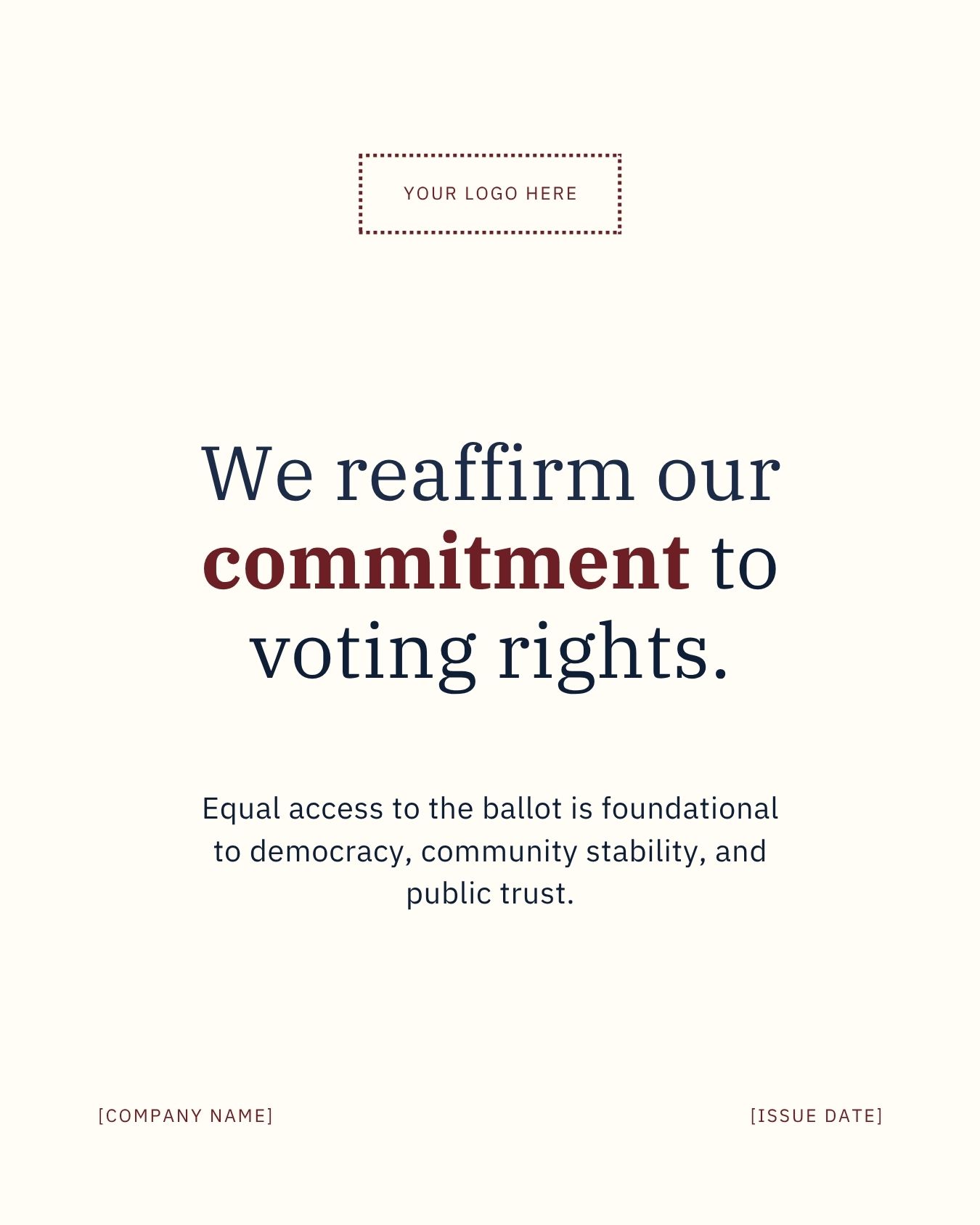
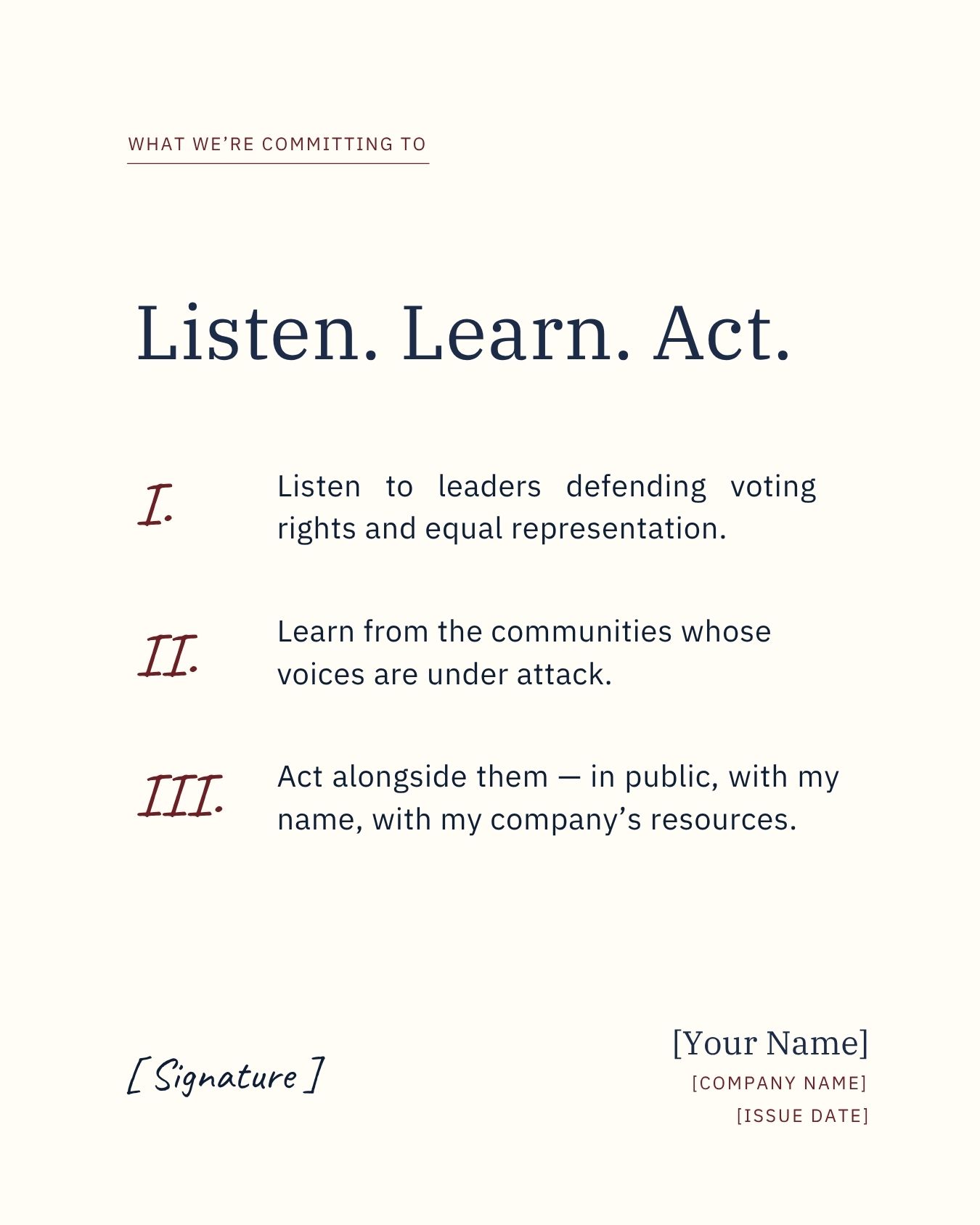
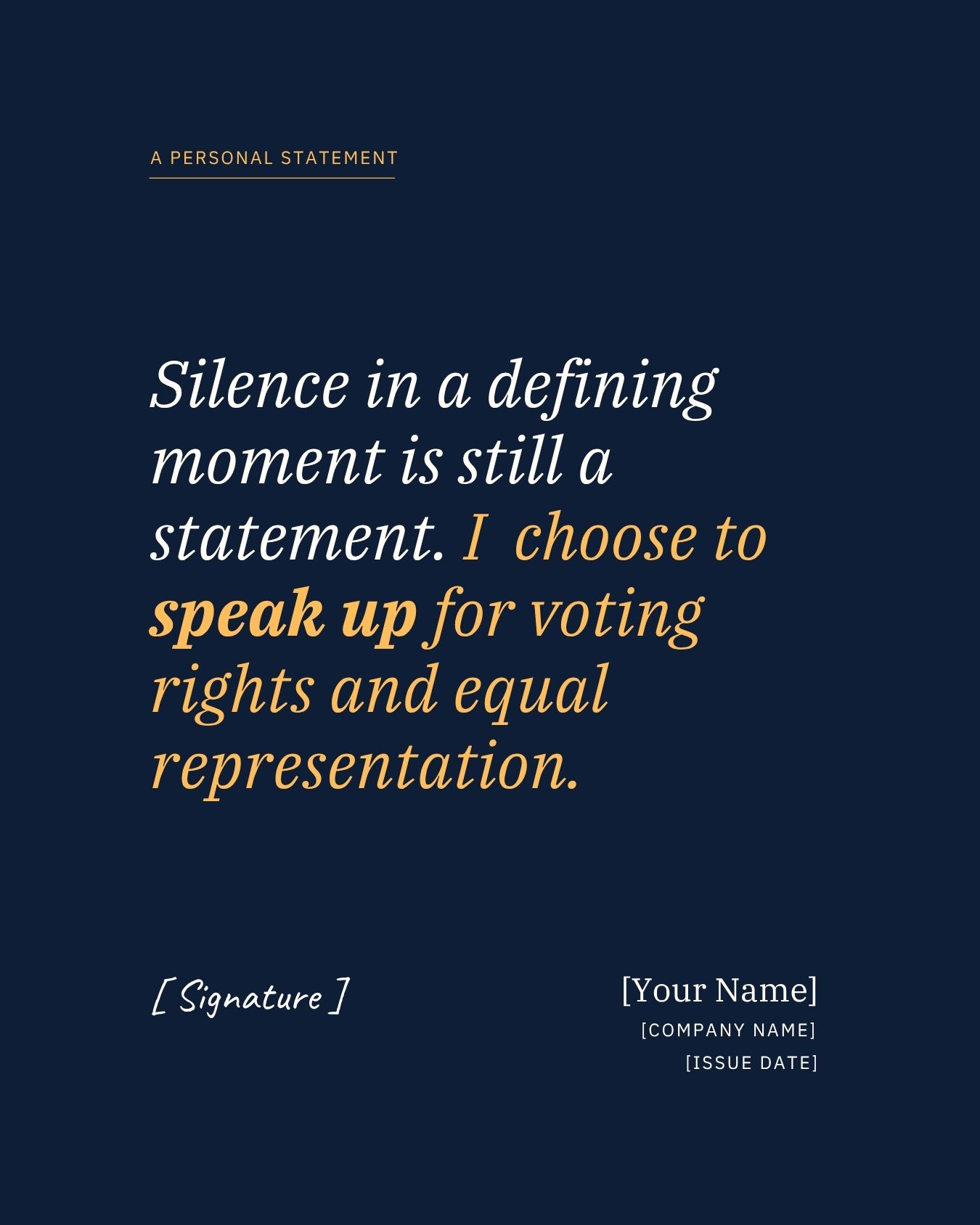
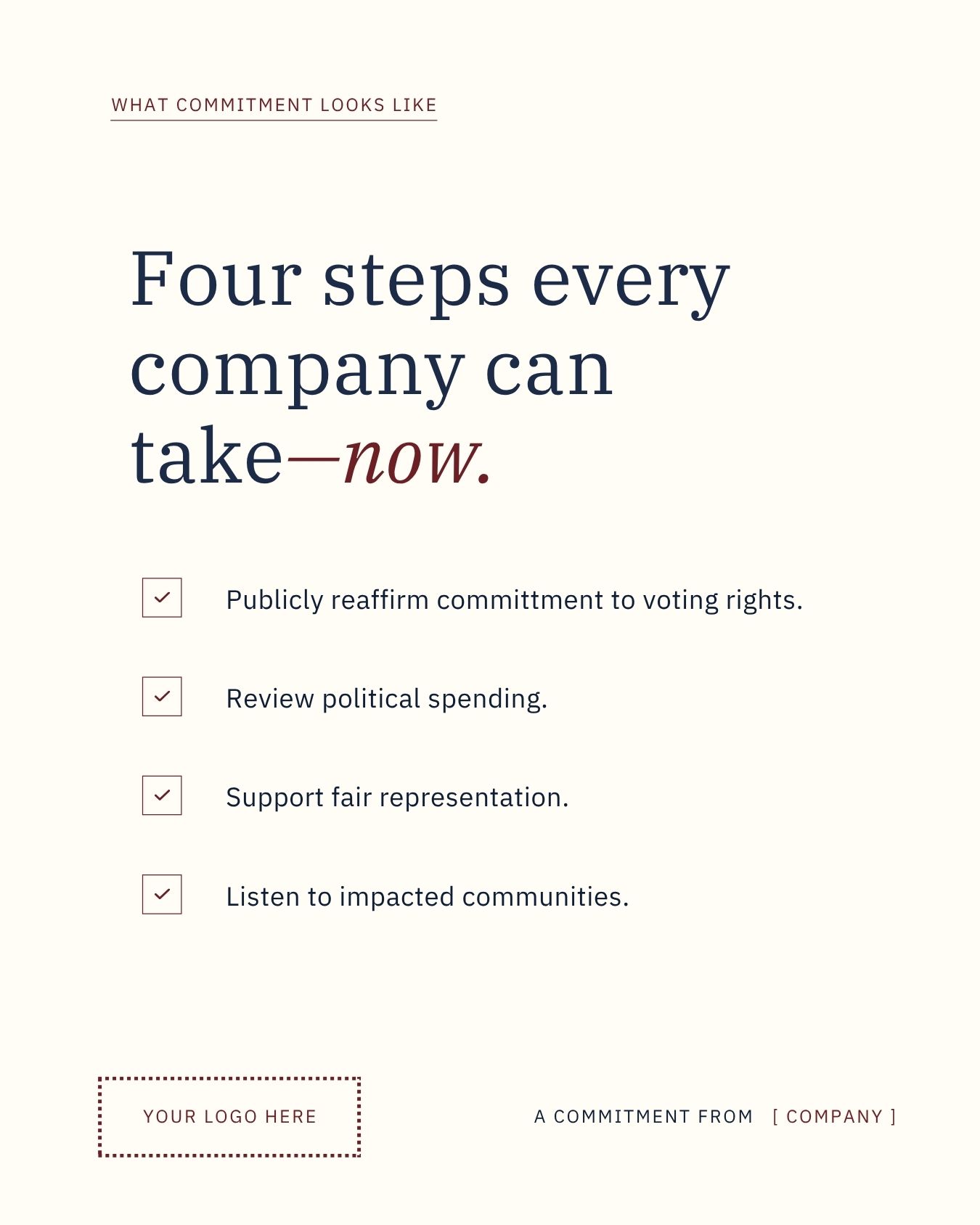
Canva templates for your social response
Four pre-built social posts to publish alongside your formal response — Instagram, LinkedIn, or your newsroom. Open in Canva, swap your brand colors and copy, and publish.
T01Instagram / LinkedIn
Company reaffirm
A clean square post for re-stating your company's voting rights commitment from 2021 in the current moment.
Customize
[Company name & logo] · [Brand colors] · [Reaffirmation copy] · [CTA / link to full statement]
Need any customized for your brand, or want additional formats? Ask Spero Studio →
Supporting context · expand as needed
01
Peer benchmarking
2021 signatories & op-eds
Peer signatories — 2021 voting rights letter
In July 2021, 250+ companies publicly signed the Business for Voting Rights letter to Congress, calling for federal protections of voting access. The CBC is tracking which of these signatories respond in 2026.
Industries represented across the 2021 signatory list include technology, financial services, consumer brands, retail, telecommunications, media, professional services, and healthcare. The signatory list is publicly available — verify your company's status, and review which industry peers are on record, directly at the source.
Concrete examples from 2021 signatory partners that put their position on the record. Useful as reference for tone, framing, and the business case — and to show leadership that this is well-trodden ground.
Vincent Evans, Executive Director, Congressional Black Caucus
Common objections — prepared responses
"Won't this politicize our brand?"
Voting rights and protection of the Voting Rights Act are not partisan positions — they are foundational to representative democracy and have historically had bipartisan corporate support. Your 2021 signature (if applicable) and the broad corporate precedent already establish that this is a governance and rule-of-law issue, not a culture-war issue.
Frame your response around constitutional protections, governance, and long-term enterprise risk — not policy preferences on any specific election outcome.
"What about our PAC contributions to both parties?"
Responding to the CBC letter does not require ending bipartisan giving. The CBC's specific ask is transparency on contributions and relationships tied to officials and organizations advancing discriminatory redistricting — a narrower and more defensible threshold than ending political engagement.
The defensible path: audit your PAC, identify any contributions to candidates or organizations directly linked to redistricting cases, and disclose your findings and policy going forward. Continued bipartisan giving on unrelated issues is consistent with this stance.
"Can we let our trade association speak for us?"
No — and the CBC will name this dodge specifically. The letter asks companies directly, not their trade associations. Hiding behind association membership is the same posture many companies took on January 6, 2021 and was widely criticized.
If your trade association has taken a position opposing voting rights protections (cross-reference ALEC and SPN member lists), the CBC will count that against you unless you publicly distance the company from that position.
"What if our PAC has contributed to redistricting-linked officials?"
This is the most common scenario and the most defensible if handled directly. The credible response is:
1. Acknowledge the contributions in the response letter (do not pretend they did not happen). 2. Commit to a specific PAC review with a stated completion date. 3. Outline criteria you will apply going forward. 4. Update ESG and proxy statement language in the next cycle.
What loses trust is silence, denial, or vague promises. Specificity earns credibility even when the record is imperfect.
"Is a private letter to the CBC — without any public statement — enough?"
No. The CBC is not accepting private acknowledgments as satisfaction of the request. A confidential letter directly to Rep. Clarke and the CBC office, with no accompanying public position, will not be counted as a response — the CBC has been explicit on this point.
Companies that previously planned a "private letter only" path should move to the Targeted response path: a narrowly scoped public statement plus the CBC letter and convening attendance. That remains the most defensible route for respondents who are not ready for full contribution disclosure.
"We are heavily regulated — what about government contract exposure?"
The CBC's posture rules this out as a reason to stay entirely private. A narrowly scoped public statement focused on the Voting Rights Act and the Callais decision — framed as constitutional and governance, not partisan — is the route most regulated respondents are taking. It is consistent with prior corporate positions on rule-of-law issues and avoids opening a new disclosure surface around political contributions.
What is not credible under the CBC's stated framework: silence framed as caution, or a private letter offered as a substitute for a public position. Both are read the same way as no response.
"What is the actual risk of not responding?"
Concrete, near-term risks: (1) the CBC and partner organizations document and publish the list of non-respondents, especially companies that signed in 2021; (2) employee resource groups, investor stewardship leads, and consumer-facing media flag the silence; (3) the contrast with peer signatories who do respond is publicly visible.
Reputational impact compounds with each cycle of inaction. The 2021 signatures are already public — silence in 2026 reverses that documented commitment without explanation.
Spero Studio
Need a partner on the actual draft?
Spero is a creative studio working with corporate affairs teams to move from this framework to a sent response — internal stakeholder alignment, copywriting, branded Canva templates, and the conversations that follow. Email us directly; we respond within one business day.
Step 2 of 4
Step 4 of 4
04
Track commitments and follow-through
Accountability · Post-response
▾
Track Commitments and Follow-Through
Response deadline: June 9, 2026
Two weeks from the date the letter was sent · May 26, 2026